Documenting Downtown Atlanta: On Long-Term Observation and Photography
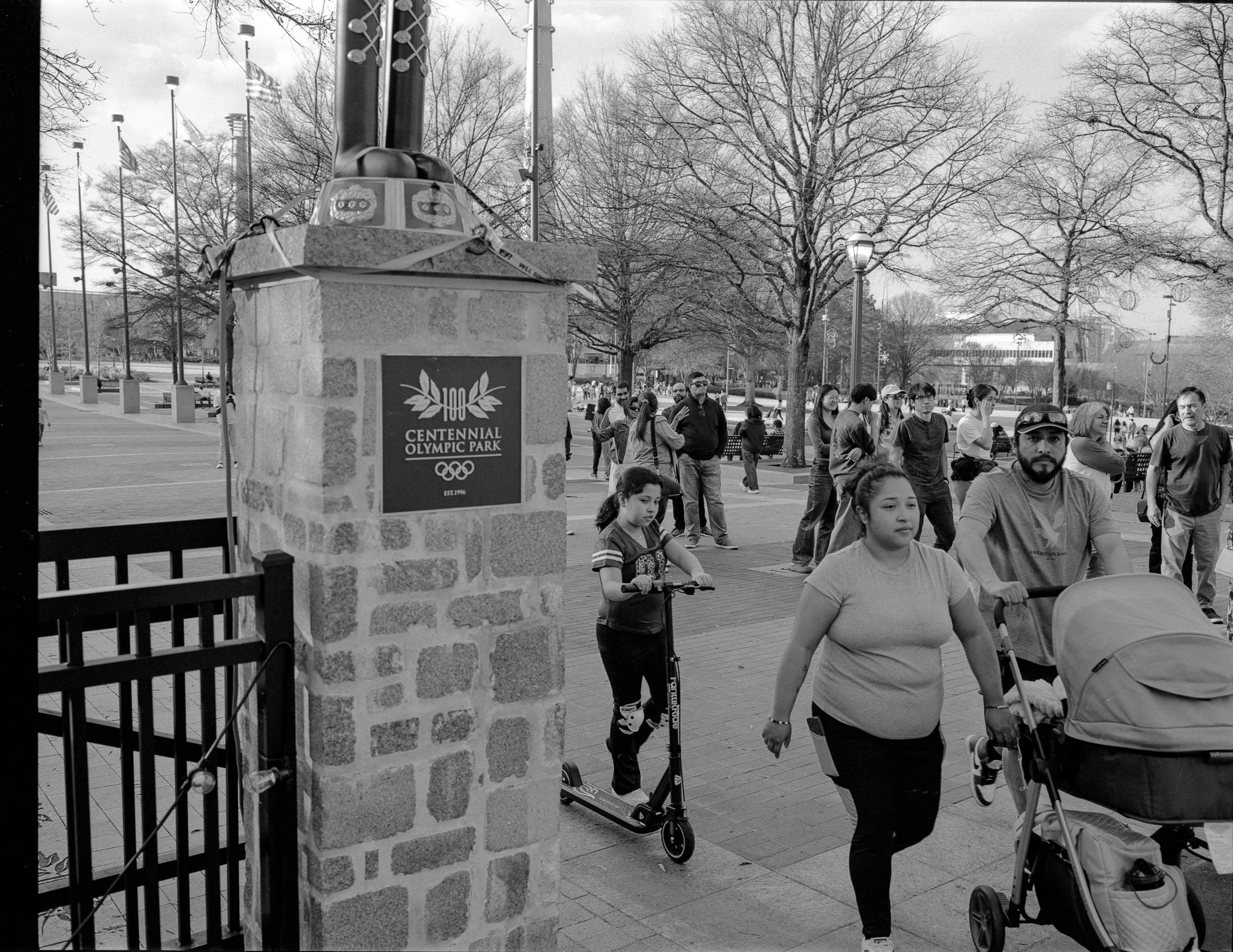
I was moving through Centennial Olympic Park in the late afternoon, watching the city breathe. Tourists cutting diagonals across the lawn. Office workers descending toward MARTA. Children weaving between fountains while security held their posts at the margins. I’ve walked this ground more times than I care to count, and still it asks something new of me each time I return.
But there are days when nothing asks anything at all. The park sits quiet, undisturbed. A few souls pass through without lingering. The light falls flat. The energy dissipates. These are the more challenging days to engage with a camera, yet they hold as much truth as the animated ones. A city is not solely its crescendos — it is the pauses, the ordinary, the still moments when nothing performs and everything simply is.
Downtown Atlanta is where many assume they’ve grasped the city. It’s been mapped, branded, and photographed into familiarity. Yet it remains one of the most difficult spaces to document with honesty. Not much motion. Too many preconceived narratives stacked atop the present. Without care, you risk producing images that echo what’s already been made, adding little to the conversation.
I’ve been studying the photographers whose work endures across decades. What unites them is not access or spectacle — it is depth. They did not merely pass through significant places. They inhabited them. They observed how bodies moved through space across different hours, seasons, years. They photographed the charged days and the dormant ones. Their authority emerged not from proclamation but from presence.
That is how I approach Atlanta, particularly downtown.
I do not photograph Centennial Olympic Park because it carries symbolic weight. I photograph it because it functions as a crossroads. Stand in one position long enough and you witness three iterations of Atlanta moving past you — the version curated for tourists, the one navigated by locals, the one occupied by labor. The work is discerning which Atlanta demands attention in any given moment, and when stillness itself becomes the subject worth framing.
In this photograph, a child glides past on a scooter, a woman guides a stroller forward, tourists drift through the background like ambient sound. The Olympic marker anchors the frame as it always has, a monument to what this place was meant to signify. Nothing dramatic unfolds here. That is precisely the point. This is what downtown looks like most days — people simply moving through space, attending to their own trajectories. Three Atlantas occupying the same stretch of pavement for half a breath.
The decision to document the ordinary comes only through accumulated time on the ground. Through understanding when to wait and when to advance. Through recognizing that some days the work is presence itself, even when the visual yield feels uncertain. Documenting a city is not an exercise in collecting peak moments. It is constructing a visual record capacious enough to hold contradiction — jubilation alongside exhaustion, structure alongside improvisation, dignity alongside survival, motion alongside stillness.
The photographers I respect never announced their mastery. It revealed itself through the work. They knew their cities block by block, not merely through historical fact but through embodied rhythm. They understood how light behaved on certain corners. How people inhabited space differently depending on time and circumstance. How a place existed when stripped of spectacle. That knowledge surfaces in the images. The photographs carry a settled quality, even when the scenes depicted are unresolved.
That is what I am building with Atlanta.
I document all of it — downtown, the neighborhoods, the edges, the transitions. The activated days and the silent ones. I am not pursuing novelty. I am tracking continuity. Observing how Centennial functions as stage, buffer, or gathering site depending on the day’s demands. How downtown shifts when conventions vacate and locals reclaim the rhythm. How the city looks when no one is performing and existence requires no audience.
These details do not surface quickly. They are earned through return. Through lifting the camera on days when it seems there is nothing worth capturing.
There is a meaningful distinction between visiting a city and working within it. Visitors extract impressions. Working photographers cultivate understanding. My practice is rooted in sustained observation, not the urgency of assignment. That patience allows the photographs to breathe. It is why they will endure.
When people encounter my Atlanta work, I want them to sense that grounding. To recognize these images emerge from someone who knows this city — not merely its appearance, but its comportment. The authority is not performed loudly. It resides in restraint. In the willingness to allow a scene to remain ordinary and still warrant documentation.
The photographers whose work I admire did not chase relevance. They constructed it incrementally through commitment to place. Atlanta merits that same devotion. Downtown merits that quality of attention.
So I will continue walking Centennial Olympic Park. I will continue circling the downtown corridors most people hurry past. I will continue making photographs that contribute to a larger archive rather than seeking to exist as isolated moments of drama.
Instagram.com/decaturstan